Coaching in Real Time Starts Long Before the Moment Itself
In healthcare, some of the most meaningful coaching happens in real time.
Not in a classroom.
Not during annual competencies.
Not in a formal performance review.
It happens at the bedside, during shift change, while responding to a patient concern, or in the middle of a busy day when a staff member needs guidance, encouragement, or redirection.
Yet many educators and leaders make the mistake of believing that effective coaching begins in that moment.
It doesn’t.
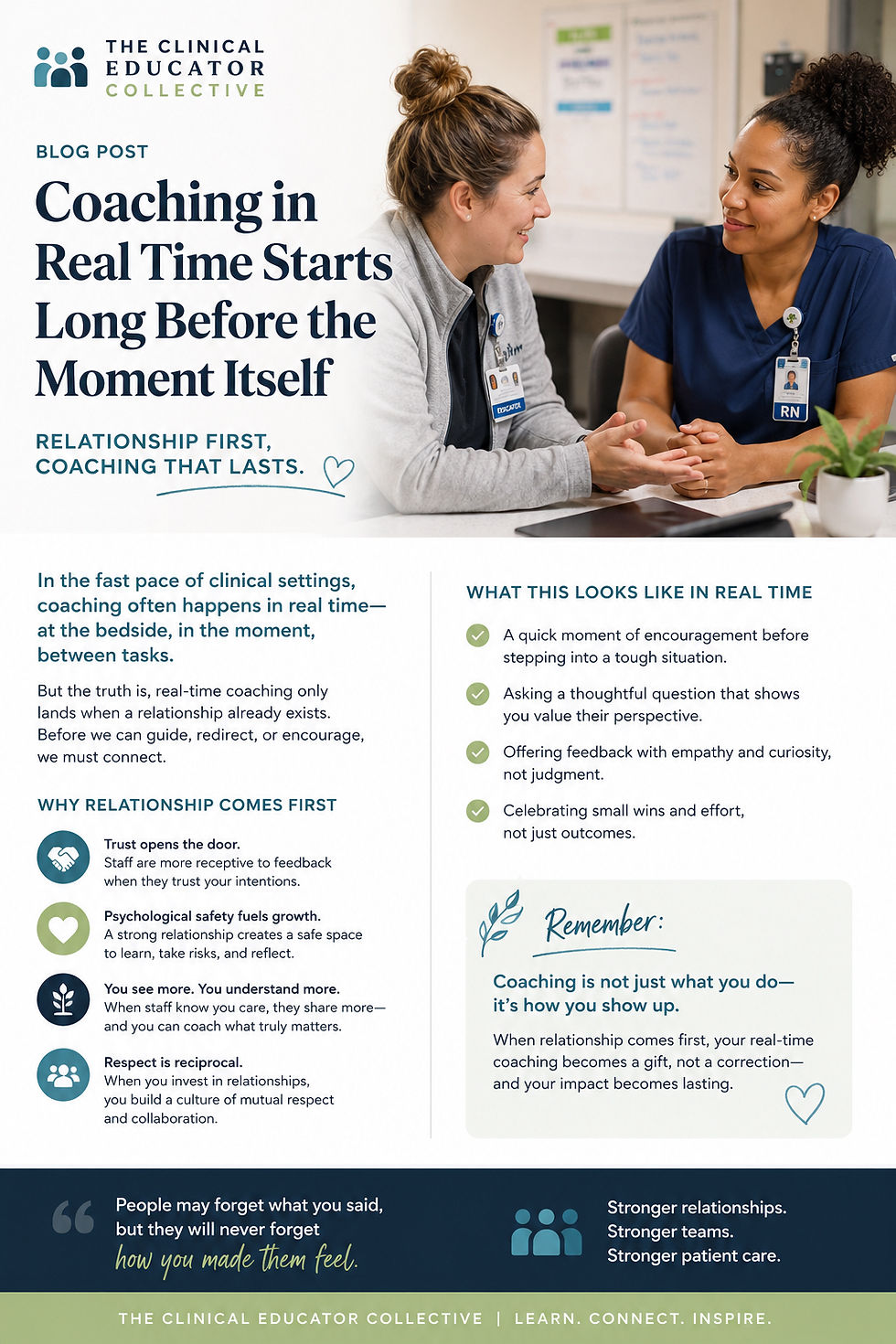
Real-time coaching starts long before the coaching conversation ever takes place.
The Foundation of Effective Coaching: Relationship
Think about the people who have had the greatest impact on your professional growth.
What made you listen to them?
Was it their title?
Their credentials?
Their years of experience?
Maybe a little.
But more often, it was because you trusted them.
You knew they cared about your success. You believed their feedback was intended to help, not criticize. They had invested time in getting to know you before they needed to coach you.
Trust creates receptiveness.
Without trust, feedback feels like judgment.
With trust, feedback feels like support.
Why Relationships Matter in Clinical Education
Clinical educators are uniquely positioned to influence practice, but influence isn’t built through expertise alone.
The most effective educators:
Spend time on the units
Learn staff members’ strengths
Understand individual learning styles
Celebrate successes
Show genuine curiosity
Follow through on commitments
When educators consistently show up, staff begin to see them as partners rather than auditors.
That distinction changes everything.
When a relationship already exists, a nurse is more likely to accept feedback about documentation.
A nursing assistant is more likely to ask questions about patient care.
A new graduate is more likely to admit uncertainty before making a mistake.
Relationships create psychological safety, and psychological safety creates learning.
What Real-Time Coaching Looks Like
Real-time coaching doesn’t always involve correcting performance.
Often, it looks like:
Recognizing excellent practice in the moment
Asking reflective questions
Reinforcing critical thinking
Providing encouragement during difficult situations
Helping staff connect actions to patient outcomes
Sometimes the most powerful coaching statement is not, “Here’s what you should do.”
It’s, “Tell me what you’re thinking.”
That simple question communicates respect, curiosity, and confidence in the learner’s ability to grow.
Building Relationships Before You Need Them
If you only appear when there’s a problem, staff will associate your presence with criticism.
Instead, intentionally invest in relationships every day.
Try:
Rounding with Purpose
Spend time on the unit when you don’t need anything.
Ask staff:
What’s going well?
What barriers are you facing?
What would help you provide better patient care?
Listen more than you speak.
Catch People Doing Something Right
Recognition builds credibility.
When staff hear positive feedback regularly, they are less defensive when constructive feedback becomes necessary.
Learn Their Goals
Understanding what motivates each team member allows you to personalize your coaching approach.
Some staff want leadership opportunities.
Some want clinical expertise.
Some simply want confidence in their role.
People are more receptive when coaching aligns with their goals.
Be Consistent
Relationships are built through repeated interactions, not grand gestures.
Showing up consistently matters more than showing up perfectly.
The Educator’s Mindset
As educators, our goal is not to be the smartest person in the room.
Our goal is to help others grow.
That requires humility, curiosity, and genuine connection.
The strongest coaching conversations happen when staff know:
You respect them.
You believe in their potential.
You are invested in their success.
When those things are present, coaching becomes less about correction and more about development.
Final Thoughts
Real-time coaching is often viewed as a communication skill.
In reality, it is a relationship skill.
The conversations that change practice, improve performance, and strengthen teams are rarely built in a single moment.
They are built through trust earned over time.
Before we can guide, redirect, or teach, we must connect.
Because coaching is not simply what we do.
It’s how we show up.
And when relationship comes first, our impact lasts far beyond the moment itself.


Comments